Basic
Muskie Fishing
By
Jim Smith
Muskie, musky, muskellunge, etc. whatever you call
it, it is the fish of 10,000 casts. I
guarantee you they’ll wait you out. I
told this to a friend on one of his first trips muskie fishing with me. An hour or so later I noticed his mouth
moving and no voice. I asked him if he
had had a follow and was talking to himself under his breath. “No,” he said, “just counting.” “It’s a joke I said,” I don’t think he was
impressed.
Let me explain the different
spellings. Muskie is predominately a
Esocidae is the family of
fish from which the muskellunge is a member.
Along with the northern pike, amur pike from
the
Distribution Muskies are a game
fish native to
Growth & Size Without a doubt,
“Big is Better”, when it comes to muskie fishing. Size limits within the various states are
working to protect the harvest of smaller fish.
Most minimum size limits begin around 36”. I know of no state with a minimum size limit
less than 30” and in the better muskie states the minimum size limit is start
at 44”, 46”, 54” etc. Many times certain
lakes within the state will have varying size limits.
A young muskie hatched in April or May of
the year will reach 7”-9” by fall. By
the following spring that fish is in the 13” to 15” size. By their third year most have reached a 30”
size. Hybrids can reach 50” by their
sixth year. Muskies tend to grow long
for their early years and then begin to fill (deepen). True muskies have been known to reach thirty
years old. Hybrids, because of their
rapid early growth, tend to achieve a maximum age of around 18 to 20
years. The world record muskie is 69# 11
oz. The world record Hybrid is 51# 3
oz. When you see photos of these fish
you’ll appreciate how deep these fish were.
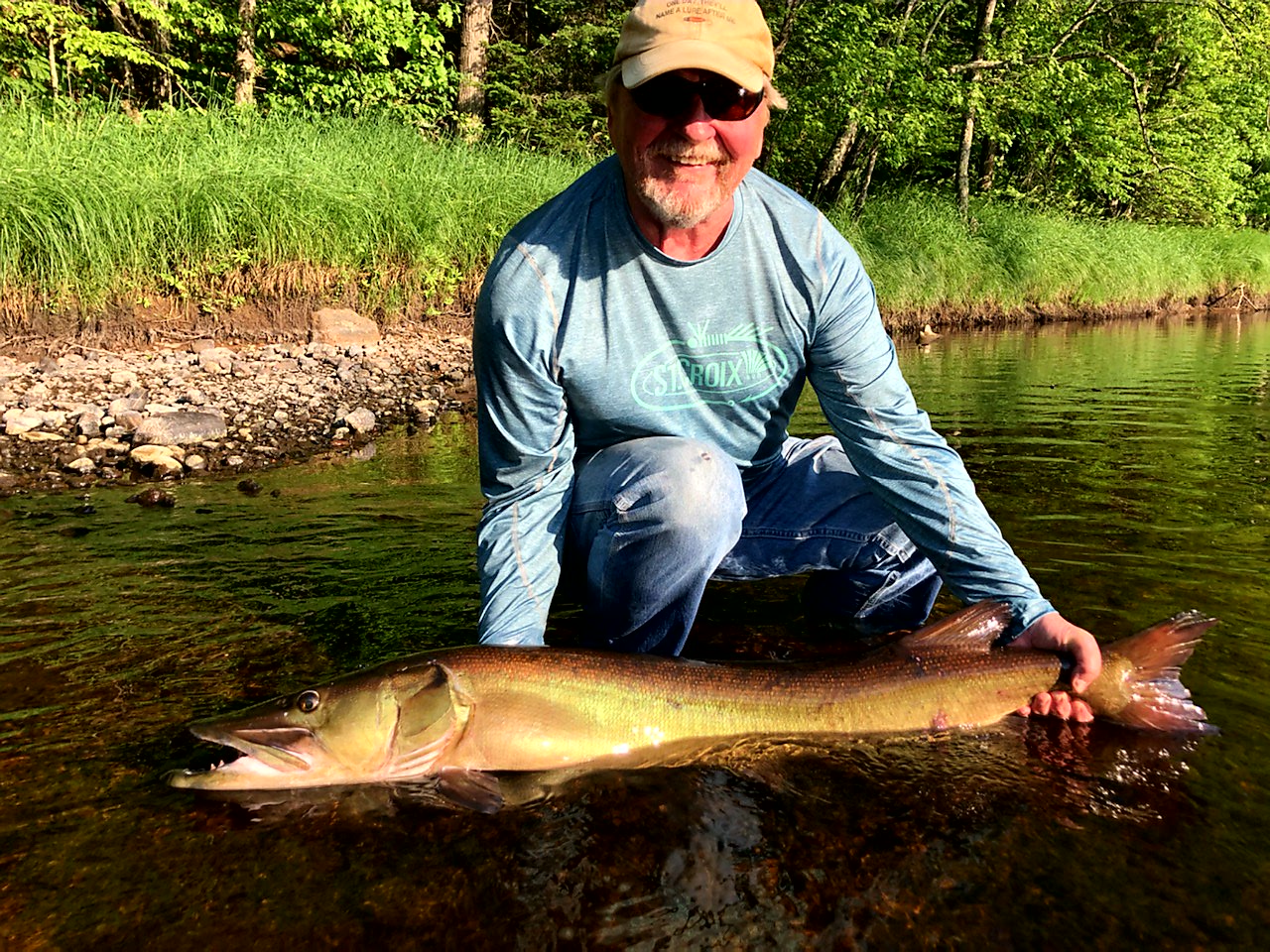
Most muskie fishermen consider a fish over 50” to be a wonderful
trophy. A fish over 55” is considered a
world-class trophy. I do not know of a
certified/recorded muskie exceeding 64” in length. That doesn’t mean that they don’t exist. You’ll hear numerous stories of super fish
weighing as much as 102#. A generally
accepted basic formula to determine the weight of a muskie is: weight (lbs.) =
(girth-in) x (girth-in) x (length-in) divided by 800. So a 50” muskie with a 30” girth would be
30”x 30” = 900 x 50” = 45,000 divided by 800 = 56.25#
Diet Because the muskie is generally the
largest fish in the lake, many believe that they sit at the top of the predator
chain, eating all the other fish in the lake.
Studies have shown that a muskie’s diet
consists mainly of soft-rayed fish, i.e. suckers, minnows, carp, ciscos, and bullheads.
In fact studies of muskie diets across
Next look for drop-offs
or breaklines. This is where the bottom of the lake
contour changes abruptly. This
transition from a shallow area to deeper water is sure to hold muskies. You can locate these breaklines
by reviewing the contour lines on your lake maps, by noting the change in water
color on the surface (darker water color indicates deeper water, lighter water
color is reflecting the bottom, shallower water.) and of course with your
electronics (sonar). Sometimes you will
be able to see a difference in the wave patterns from deeper water to shallow
areas. Work around islands, reefs, bars,
and stump areas to find dropoffs. Note land contours along the shore. These will give you hints about dropoffs and breaklines. Work these edges, casting to shallow from
deep. Keep your boat into the deeper
water. Cast or troll along the breakline, parallel with the edge. Muskies are an ambush fish. They tend to locate along these edges waiting
for some innocent fish to come meandering by and ZAP! Gulp! Hopefully that was your lure.
Finally, we have a class of muskie holding
areas called structure. Structure
refers to underwater rock piles, bars, reefs, stump areas, etc. The same two
factors that apply to weed beds apply to structure – size and variety. In most cases the larger the reef or bar the
better it should be. The more varied it’s composition is the more hiding places there will be to
hold muskies. By “varied” we are looking
for large and small boulders, pockets, bends, variation in depth, rubble as
opposed to sheer rock, crevice-filled rock slabs, etc. Another important
feature is that anytime you can find this structure located close (next) to
deeper water, you have an ideal location for muskies.
When
to fish for muskies? Anytime
you can get on the water is a goodtime.
Note I said a “goodtime”. One thing that is nice about muskie
fishing you don’t normally have to get up before sunrise to be on the water at
daybreak. Actually, the best time for
muskies is the last hour of daylight.
Remember muskies are a low light fish.
They like dark, overcast, drizzly, cool days the best. Slight chop on the water, wind from the west,
falling barometer, full moon….you’ve got it all now. If you look at the statistics you’ll see
patterns emerging. In Muskies, Inc. we
have a database of over 150,000 released muskies. This information is important to any muskie
fisherman. Some muskie fishermen get
paralyzed with statistics and won’t do anything without first consulting every
possible almanac and reading every meter, graph, chart, etc. Phooey! Muskie fishing is a fun,
entertaining, mostly relaxing, enjoyable passion. Being on the water is the most important part
of the experience. That is why it is
called fishing instead of catching.
Weather. Muskies tend to go on a feeding flurry during
a falling barometer, just preceding a storm front. Cold fronts will turn muskies off after the
front has passed. But, if you fish the
later afternoon when the water temperature has peaked for the day, you have a
good chance to hit a peak feeding time.
Using smaller lures and slower retrieves will increase your chances. If
the day is sunny and bright they will feed just before sunset, the last hour of
daylight. Overcast windy days are much
better than calm sunny ones.
Water depth If you look at the
statistics 66% of the muskies are caught in less than ten (10 ‘) feet of
water. 5’ to 8’ seems to be the most
popular depth for muskies.
Water temperature Muskies are most active in
water temperatures between 55° and 72°.
The peak fishing temperature is 68°.
Trophy fishermen prefer water temperatures of 55°. When water temperatures are in the 60°-68°
ranges use a slow retrieve.
Moon phases This is a rather
emotional topic for discussion. There
are those who think moon phases are a religion and then there are the rest of
the fishermen. There are charts galore,
so if you “believe,” you’ll have a wealth of information with which to choose
from. Suffice it to say that the biggest
fish have generally been caught around the NEW moon followed by the FULL
moon. The best days are the five days
following the new moon and the four days following the full moon. Statistically the best two days are the day after
the new moon and the forth day after the full moon. Night fishing under a full moon after it has risen, is not as productive as the early mornings. However, cloud cover during a full moon will
keep the bite alive.
Seasonal patterns As you have seen
there are many elements that go into muskie fishing. What it requires is for us to decide what
elements or things are important in order to catch a big muskie. We must pick and choose those things that we
think will work This
is why we look for “patterns”. A pattern
is something that does or has worked.
Establishing a pattern is doing something that changes what you have
been doing unsuccessfully and provides you a path to success. There are many elements to successfully
catching muskies, or any fish for that matter.
Coordinating each of those elements and organizing them into a
successful pattern is what the experienced muskie guide or fishermen does and
is what you and
I should do.
Look
at the trends from the statistics compiled by Muskies, Inc. Look at the records from the Fresh Water
Fishing Hall of Fame. You will begin to
see things that have worked.
When
we talk about seasonal patterns we are mostly looking at spring, summer and
fall. These seasons can be further
divided into varying segments that affect muskie movements. For example, most fishermen fish during the
months of June, July and August. Thus,
the most pressure, most fishermen, most catches. However, May and September are the best
months for desirable water temperatures.
October and into November are traditionally the best months for the big
muskies.
Springtime
means you are looking for south facing bays, as they will warm up sooner. Warm creek or river inlets will draw
muskies. This is considered the post
spawn time and is usually a tough time for muskies. Use small lures, the water will be cold 50°
to 58° F. Then comes
pre-summer. This is usually a
sporadic or transition period. This is
followed by a short two-week period around the middle of June. This is a hot! time
for the muskie bite. Around June 21st
we begin the summer months. Fishing is
best in the early mornings before 8:00 am and in the evenings after 6:00
pm. Getting into August we find cooler
days and calmer waters. Then around late
August to mid September turn over occurs.
Turn over is a brief period of chaos where water changes density
as its temperature changes. The summer
has warmed the surface water causing temperature stratification in the
lake. Warm less dense
water on top and cooler denser water on the bottom. As fall comes upon the lake the surface water
begins to cool. The colder water being
denser descends to a shallow band of very cool water called the thermocline. Below the thermocline band is cool, stable
water, temperature wise, which now is actually warmer than the cool water above
the thermocline. Pretty
soon this denser, heavier cold water above sinks causing the cool, stable,
warmer, less dense water on the bottom to rise to the surface. Thus you have turnover. On large bodies of water you may have turn
over occurring in different parts of the same lake. Things like lake depth, high wind and
changing weather conditions can affect the temperature stratification. Although you may as well stay at home and
watch the fishing shows on cable during this period, rejoice in the fact that
this is only a relatively short period and there are truly better days
ahead. In fact the year’s best muskie
fishing lies just ahead.
By
late September or early October as the water temperature hits 55° it is prime
time muskie fishing. There is not a bad
day until ice up or the season ends.
Proper handling
& release techniques
EXTRA HELPERS:
Use barbless hooks (flatten bard with pliers or file down).
Use artificial
lures only.
If using live
suckers, always use a “quick strike rig” Never use single hook.
Clip one of the
three treble hooks.
Use proper
equipment so you can bring the fish in more quickly.
DON”T:
Don’t drop the fish
in the boat.
Don’t net or handle
a fish if you can leave it in the water.
Don’t release a
fish that can’t right itself and bobs to the surface.
Any fish not of
legal size must be released regardless of its condition.
Don’t place fish
you plan to release on a stringer or in a live-well.
What is the future
of muskie fishing?
End………..